Pedal cycles, PABs and PMDs around Singapore roads
Current road-conduct, equipment and footway rules for bicycles, pedal cycles and power-assisted bicycles, driver guidance for sharing roads with cyclists, active-mobility insurance guidance, and statutory road-use restrictions for PMDs and mobility vehicles.
Primary source: https://sso.agc.gov.sg/SL/RTA1961-R3
The Road Traffic (Bicycles, Three-wheeled Pedal Cycles, Trishaws and Recumbent Devices — Road Conduct) Rules apply road-conduct requirements to bicycles, specified pedal cycles, trishaws, recumbent devices, and power-assisted bicycles (PABs) (Singapore Statutes Online, Road Conduct Rules).
On a road, a rider must not tow another vehicle, be towed by another vehicle, or hold onto another moving vehicle. A bicycle or PAB may carry no more people than it is designed for; a pillion passenger must have a designed pillion seat, subject to the stated child-seat exception. No person below 16 may be carried as a pillion passenger on a PAB (Singapore Statutes Online, rules 3–4).
Riders must signal in sufficient time, ride with traffic and as near as practicable to the far-left edge, and travel in an orderly manner. They must not ride to the right of a motor vehicle travelling in the same direction except to overtake it. On a single-lane road, riders must not remain abreast with another rider to their right; overtaking another cycle rider is allowed. Riders may ride abreast in one lane on a road with at least two lanes for traffic travelling in the same direction, but not in an operating bus lane (Singapore Statutes Online, Road Conduct Rules, rr. 5–8 and 10–11).
Cycling groups and bicycle lanes
A “cycling group” under the Rules is a group with a common intention to meet to ride together, or an agreement or understanding to ride as a group. On roads, the usual maximum is 5 bicycles, three-wheeled pedal cycles, recumbent devices or PABs in a group. A group of 6 to 10 may ride together only if the road has at least 2 lanes for vehicles travelling in the same direction, riders do not use an operating bus lane, and at least (group size × 2) − 10 members of the group ride abreast of another member. The group-size limit does not apply on a section that is a full-day bicycle lane, or on a part-day bicycle lane on Sunday from 5 a.m. to 11 a.m.; this exception is to the limit in rule 7A(1), not a waiver of other road-conduct rules. Riders in any cycling group must keep a distance from the rider ahead that is no greater than the distance needed to manoeuvre safely (Singapore Statutes Online, Road Conduct Rules, rr. 7, 7A and 7B).
Where a full-day bicycle lane exists, riders must use it rather than another part of the road, unless there is a reasonable excuse. The same applies to a part-day bicycle lane on Sunday from 5 a.m. to 11 a.m. LTA identifies the part-day lanes as Tanah Merah Coast Road and West Camp Road during those Sunday hours. The Road Traffic Rules state the operating-time restriction and reasonable-excuse qualification; the Highway Code describes blocked or obstructed lanes, and making a U-turn or right turn, as situations for leaving the lane (Singapore Statutes Online, Road Conduct Rules, r. 7B; LTA, Rules & Code of Conduct; Singapore Statutes Online, Highway Code, para. 30).
During the hours of darkness, a bicycle, PAB, and the other specified vehicles must display a clearly visible white front light and a red rear light or reflector. The construction-and-use rules also set a maximum road length of 2,600 mm and width of 1,300 mm for a bicycle, three-wheeled pedal cycle, or recumbent device (Singapore Statutes Online, Construction and Use Rules 2024).
SPF separately advises cyclists to wear light-coloured or reflective clothing, switch on a white front light and red rear light in low-light conditions, and keep the bicycle regularly maintained and in good working condition. It says a rear red reflector can also improve visibility and recommends elbow and knee pads to cushion the impact of a fall. This is practical safety guidance; the legal lighting duty above is specified by hours of darkness (SPF, Road Safety Tips for Cyclists).
SPF also advises cyclists to slow down and watch for other road users at bends, junctions, bus stops and pedestrian crossings; remain alert to larger and faster road users; watch for children and older pedestrians; and ring a bell to warn pedestrians when approaching. When stopping, SPF says to place the left foot on the ground and dismount from the left side of the road. It advises riders not to carry items, walk a dog, hold an umbrella or occupy one hand while cycling. These are presented as safety tips, separately from the legal duties summarised above (SPF, Road Safety Tips for Cyclists).
For road riding, SPF advises cyclists not to use expressways or road tunnels, to keep a safe distance behind moving vehicles, and never to assume they have right of way. The expressway restriction also has a statutory basis: bicycles and PABs are among the excluded vehicles that may not be used on an expressway except where the rules provide for an authorisation. The Road Traffic (Expressway Traffic) Rules separately prohibit human-powered pedal vehicles, including bicycles, three-wheeled pedal cycles, recumbent devices and trishaws, and electric bicycles or trishaws capable of human or electric propulsion in road tunnels and expressway tunnels. LTA summarises the tunnel restriction as applying to bicycles, tricycles and trishaws in all tunnels. The expressway authorisation rules do not create a general permission to cycle through a tunnel. SPF's safe-distance and right-of-way statements remain safety guidance (SPF, Road Safety Tips for Cyclists; Singapore Statutes Online, Road Traffic (Expressways — Excluded Vehicles) Rules 2010, r. 3 and First Schedule; Singapore Statutes Online, Road Traffic (Expressway Traffic) Rules, r. 14; LTA, Driving on Expressways & in Tunnels).
Fixed-gear bicycles and the handbrake requirement
LTA requires manual bicycles and three-wheeled pedal cycles used on public paths and roads to have at least one functioning handbrake installed at the handlebar. The current Construction and Use Rules define a handbrake as a braking system applied by one or more hand levers attached to the handlebars; it must operate on at least one wheel and, when applied, reduce speed or prevent movement (LTA, Rules & Code of Conduct; Singapore Statutes Online, Road Traffic (Bicycles, Three-wheeled Pedal Cycles, Trishaws and Recumbent Devices — Construction and Use) Rules 2024, r. 5).
In a written reply on 7 October 2026, MOT said LTA does not track accidents involving fixed-gear bicycles or the specific demographics of their users. Since the handbrake requirement for bicycles on public paths and roads began on 1 September 2021, LTA has not observed additional safety concerns and considers the requirement adequate. LTA also said fixed-gear bicycles found non-compliant and used on public paths have declined since 2024, and that it will continue working with relevant agencies to enforce the requirement (MOT, Data on Fixed-Gear Bicycle Accidents and Youth Ridership, and Adequacy of Current Handbrake Safety Requirements).
Driver guidance for sharing the road with cyclists
LTA's road-sharing guide presents the following as motorist guidance and illustrated scenarios, not as a complete account of every traffic situation. When passing cyclists, it advises drivers to signal early, check mirrors and blind spots, leave at least 1.5 m of passing distance, and move back to the left lane only after safely passing. If conditions do not permit a safe pass, slow down behind the cyclists and wait. On roads with two or more lanes, the guide says to use the next lane when safe to pass cyclists travelling single-file or two abreast; on a single-lane road, pass only when safe (LTA, Navigating Traffic Scenarios Safely: A Guide for Cyclists and Motorists).
At junctions, LTA advises motorists to look out for cyclists turning left and give them space, and to allow cyclists travelling straight to move towards the centre of the lane. Before turning left, signal early and check blind spots; LTA's guide says to sound the horn only when necessary, to avoid startling cyclists. For cyclists turning right, the guide advises motorists to leave sufficient space and travel behind them or in the lane beside them as they approach the turn. When stopped at a junction, stop behind cyclists, keep a safe distance, and do not squeeze them to the road edge (LTA, Navigating Traffic Scenarios Safely: A Guide for Cyclists and Motorists).
At bus stops without a bay, the guide advises motorists to allow cyclists room to overtake a bus and to watch for cyclists' right-turn signals; it also advises looking out for and giving way to buses that may move into the lane when exiting a stop. The guide's bus-lane instructions are separate: drivers should not enter bus lanes during their operating hours (LTA, Navigating Traffic Scenarios Safely: A Guide for Cyclists and Motorists).
SPF's 2026 Final Theory of Driving handbook gives additional advice for drivers encountering cycling groups of more than 5 cyclists: travel between the groups, overtake only when safe, and look out for cyclists who are slowing down. This is handbook guidance (SPF, Final Theory of Driving handbook (2026 edition), para. 248).
PMD paths and device limits
LTA says motorised PMDs, including e-scooters, may use cycling paths and shared paths, but not footpaths, pedestrian-only paths or roads. Non-motorised PMDs may use footpaths, cycling paths and shared paths, but not pedestrian-only paths or roads. From 1 July 2025, bicycles and non-motorised PMDs are also barred from footpaths that have been converted into pedestrian-only paths; this change does not apply to standalone footpaths and shared paths (LTA, Rules & Code of Conduct; LTA, Where active mobility devices are allowed).
For motorised PMDs and e-scooters, LTA lists a maximum weight of 20 kg, maximum width of 70 cm, maximum motorised-device speed of 25 km/h, and UL2272 certification. LTA states that from 1 June 2026 it is an offence to keep a non-UL2272-certified e-scooter (LTA, Rules & Code of Conduct).
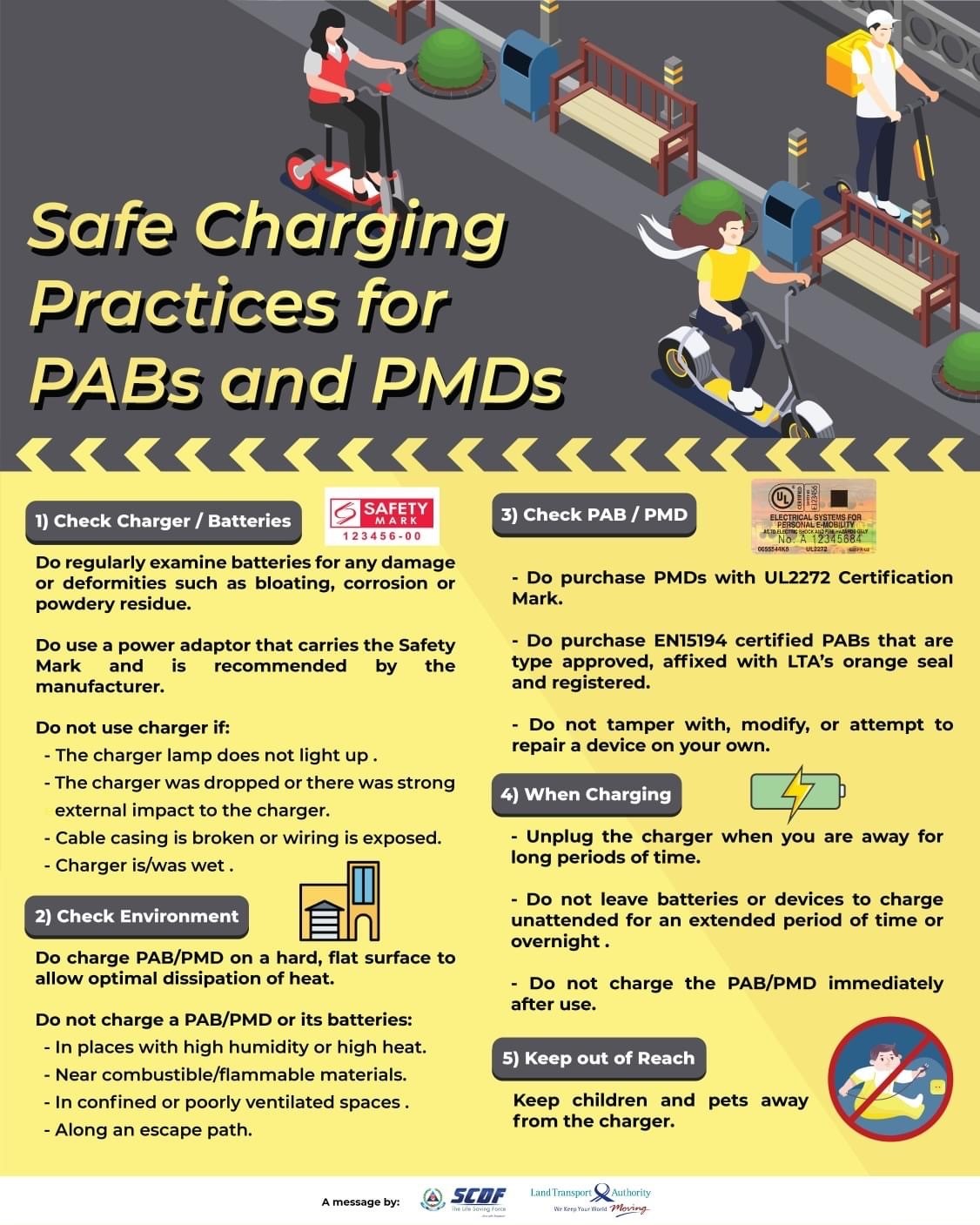
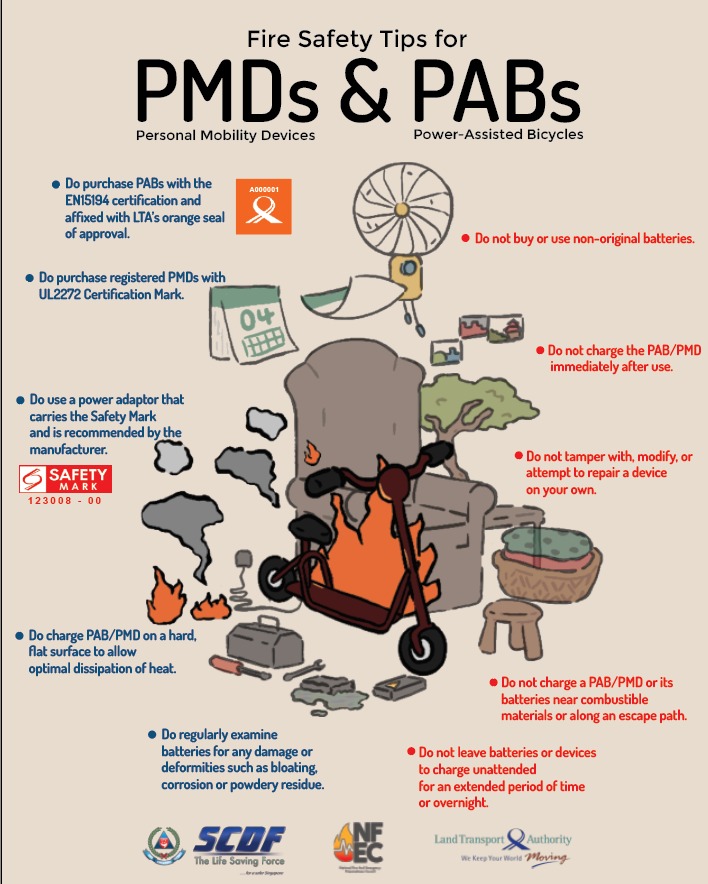
LTA advises owners of motorised PMDs, PABs and PMAs to refrain from using non-original batteries because they may pose fire risks. Its linked guidance also covers safe charging practices for motorised devices and fire-safety tips for PMDs and PABs; the advice is not presented as a separate battery-approval rule (LTA, Rules & Code of Conduct; LTA, Safe Charging Practices for Active-Mobility Devices; LTA, Fire Safety Tips for PMDs and PABs).
PMDs and mobility vehicles on roads
The Road Traffic Act prohibits riding a personal mobility device (PMD), or driving or riding a mobility vehicle, on a road. A mobility vehicle means a mobility scooter, a motorised wheelchair, or another motor vehicle prescribed for carrying a person who cannot walk or has difficulty walking (Singapore Statutes Online, Road Traffic Act 1961, s. 5A; Singapore Statutes Online, Active Mobility Act 2017, s. 2). The mobility-vehicle coverage took effect on 4 May 2026 under the Land Transport and Related Matters Act 2026 (Singapore Statutes Online, Land Transport and Related Matters Act 2026, ss. 51 and 53).
Section 5A allows either type of user to cross a road by the shortest safe route and stay only as long as needed to cross. If it is impracticable to use an obstructed adjacent area, a PMD rider may travel along the road where the obstruction is on an adjacent shared path or footpath; a mobility-vehicle user may do so where the obstruction is on any adjacent public path. In either case, travel must be no more than reasonably necessary to avoid the obstruction. A person convicted of contravening the section may be fined up to $2,000, imprisoned for up to 3 months, or both; for a repeat offence the maximum is $5,000 or 6 months, or both (Singapore Statutes Online, Road Traffic Act 1961, s. 5A).
Section 5B separately prohibits an individual on a road from riding a PMD or driving or riding a mobility vehicle while being towed by a motor vehicle or otherwise holding on to a motor vehicle. On conviction, the maximum penalty is a $2,000 fine, 3 months’ imprisonment, or both; for a repeat offender it is a $5,000 fine, 6 months’ imprisonment, or both (Singapore Statutes Online, Road Traffic Act 1961, s. 5B).
Vehicles on road footways
Road Traffic Rules r. 28 generally prohibits driving, parking or riding a vehicle on a road footway. Its exceptions include driving or riding a bicycle, PAB, PMD (including a recumbent device or three-wheeled pedal cycle), mobility scooter or wheelchair on a road footway; the listed exception permits driving or riding, not parking. Device-specific path-access rules still apply: LTA distinguishes footpaths, cycling paths, shared paths and pedestrian-only paths, and sets access by device type (Singapore Statutes Online, Road Traffic Rules, r. 28; LTA, Rules & Code of Conduct).
The rider of a bicycle or PAB must wear a protective helmet. A PAB must meet the prescribed requirements and be registered with its rear number plate affixed before it is used on the road (Singapore Statutes Online, Road Conduct Rules; LTA OneMotoring, Power-Assisted Bicycle).
Active-mobility insurance
LTA strongly encourages non-commercial active-mobility riders to purchase insurance to protect against personal-accident expenses and third-party injury claims; this is LTA's recommendation, not a general insurance mandate for individual riders. Since December 2020, licensed device-sharing operators providing motorised devices for hire and businesses that employ or contract people to ride active-mobility devices on public paths for work must take reasonable and practicable measures to ensure those riders are adequately covered by an approved third-party liability policy against injury and death during work (LTA, Rules & Code of Conduct; LTA, Mandatory Third-Party Liability Insurance Requirements for Businesses).
Coverage debt
-
This is a road-use summary, not a catalogue of every PAB approval or registration requirement, or every PMD and other active-mobility path-use or device requirement. Consult LTA's current active-mobility guidance for those details. The LTA road-sharing guide illustrates selected cyclist–motorist scenarios; it says the examples are not exhaustive.
-
SPF's cyclist safety page does not define a technical threshold for “low-light conditions” or provide an itemized bicycle inspection checklist.
-
MOT does not publish fixed-gear bicycle accident counts or user-demographic data in its 7 October 2026 reply; it does not give counts for non-compliant fixed-gear bicycles found on public paths either.
-
The expressway and tunnel advice above is recorded as SPF safety guidance; the sources cited in this article do not establish its separate statutory basis for cyclists.
Sources
-
LTA, Mandatory Third-Party Liability Insurance Requirements for Businesses
-
Singapore Statutes Online, Road Conduct Rules, rr. 5–8 and 10–11
-
Singapore Statutes Online, Road Conduct Rules, rr. 7, 7A and 7B
-
Singapore Statutes Online, Road Traffic (Expressways — Excluded Vehicles) Rules 2010
-
Singapore Statutes Online, Road Traffic (Expressway Traffic) Rules, r. 14
-
Singapore Statutes Online, Land Transport and Related Matters Act 2026, ss. 51 and 53
-
LTA, Navigating Traffic Scenarios Safely: A Guide for Cyclists and Motorists
-
Singapore Statutes Online, Road Conduct Rules, rules 7 and 7A